Lines are symbols. When I was a child, someone told me that numbers were symbols. That opened the door for hope for them because they became a lively art form, not merely restrictive, unfriendly cyphers that had to be kept in place. Our daily life is full of symbology. Those who use and interpret symbols fluently in language, science, literature and art have a deeper understanding of interrelationships among cultures, contextual meanings, definitions, interpretations, and their applications.

- Drawing
When children learn to draw, we begin to encourage their use of simple symbols. They learn patterns of lines, and begin to draw shapes. You can imagine a child’s first tree. The familiar figure of a lollipop tree is seen in countless works by children. The house is commonly represented as a triangle on top of a square, possibly with a small rectanglular chimney on the roof.
These early drawings are far removed from the more mature drawing of an adult who has learned to use line to represent a form seen in nature. This artist will carefully observe the form, and begin to sketch what is actually seen, not just place a symbol on paper that represents the idea of the form. Natural forms themselves are complex, and to sketch a form adequately takes much careful thought and practice. Getting beyond the symbol to a realistic drawing is no easy task. Each artist takes a different course as they draw a sketch, because each artist expresses a different vision based on their personality, experience, and physical abilities.
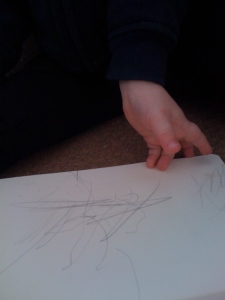 Lines are the first marks we make.
 I carry one of these Moleskeine notebooks around with me every where I go. If I have a spare moment, I pop it out and start sketching. My grandmother bought me a notebook when I was young, and told me to write in it every day so that I would not forget how to speak and write in German. I’ve taken that encouragement, and applied it to art. Having this tool accessible makes it easy to use spare moments to practice. Oh, and by the way, alles passt gut zu mir, wie geht es Ihnen?